
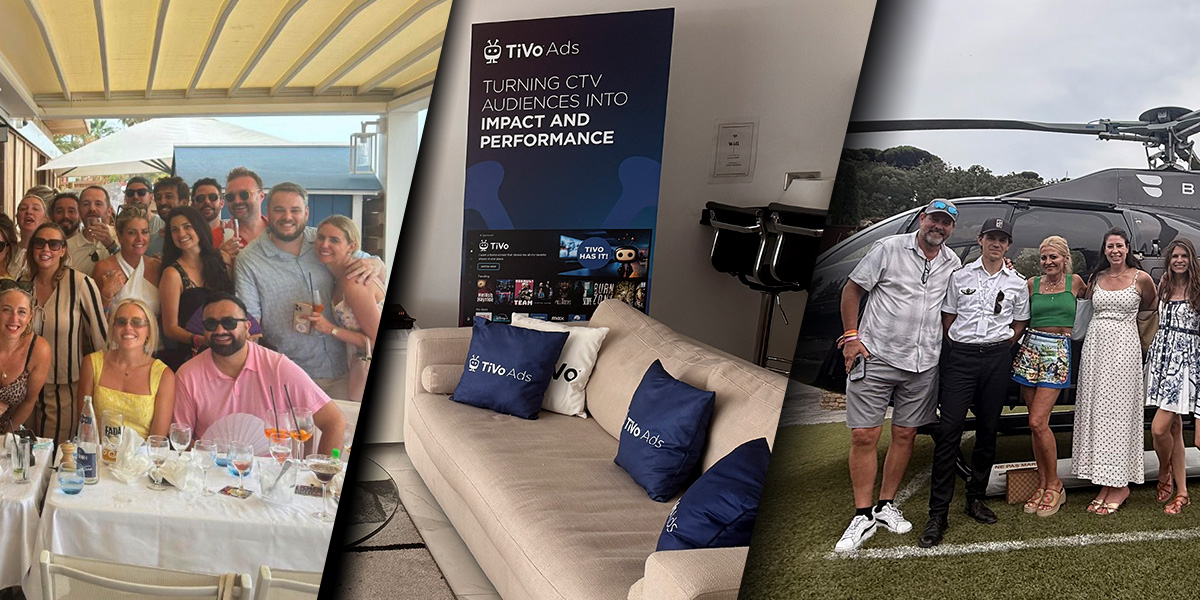
Cannes Lions is many things. Creative awards. Deal-making. The industry’s annual attempt to take stock. This year, people came with real questions — about data, who controls the TV interface and whether the industry is actually ready for the changes it keeps announcing. We were there. Here’s what we heard.
The home screen is prime real estate. Act like it.
The pre-content moment — those seconds when a viewer turns on their TV and decides what to watch — is now one of the highest-value placements in the ecosystem. It’s not an interruption. It’s discovery. And it happens every single time someone sits down to watch.
What makes it different is reach. A meaningful share of TV households are on ad-free tiers and never see a pre-roll. But every one of them navigates the home screen. That’s inventory in-stream simply can’t touch — and TiVo’s Home Page Hero Ads sit at exactly this moment, connected to genuine audience intelligence about what that household is likely to watch next.
Good data doesn’t lie. And right now, TV needs it more than ever.
One word followed every CTV conversation at Cannes: measurement. A single household today moves between linear, SVOD, FAST and AVOD in a single evening — often on the same screen. Panels can’t keep up, self-reported data is unreliable, and the walled gardens of major streamers aren’t opening.
ACR changes this. It reads what’s actually playing on a TV screen in real time — it doesn’t ask the viewer what they watched, it knows. TiVo’s viewership intelligence is built on exactly this foundation: observed behavior across millions of households, covering tune-in patterns, content engagement and genre affinities. That’s the difference between data that reflects how people actually watch and data that estimates it.
AI is a powerful tool. Human judgment is still the point.
The AI conversation at Cannes was more nuanced than the headlines suggest. The industry isn’t racing to hand everything to algorithms — it’s figuring out where automation genuinely helps and where experience, instinct and relationships still matter more. Campaign planning, audience segmentation and performance reporting are all areas where AI can remove friction. Creative judgment, client strategy and contextual decision-making are not.
The media companies and advertisers that will get the most from AI are the ones treating it as a capable assistant, not a replacement. That means investing in the data foundations that make AI useful — clean signals, accurate viewership, reliable attribution — while keeping human expertise in the decisions that shape outcomes. The goal isn’t less human involvement. It’s better-informed human involvement.
Retail media is growing up. The next test is measurement.
Nobody at Cannes debated whether retailers should be in the media business. The debate was about what that actually requires. Retailers hold precise first-party purchase data — real transactions, real households. CTV has the scale and attention environment to activate those signals in premium contexts. The combination is compelling.
But measurement fragmentation makes it hard to prove that a TV exposure drove a sale. With global retail media spend projected at $100 billion by 2027, credibility depends on solving attribution. The smart TV OS is the natural connective layer between what a viewer watches and what they subsequently buy — and the data generated there is what makes that connection verifiable.
Sports have become the last shared moment. Treat it that way.
Live sport is the last truly synchronous viewing experience at scale. While everything else in TV has fragmented into on-demand and time-shifted behavior, a major live event still brings millions to the same content at the same moment — making it the most emotionally charged context in advertising.
Brands understand this now in a way they didn’t five years ago. They’re not buying sports for reach alone — they’re buying cultural presence. For TV advertisers, that means treating sports audiences with the same precision and intelligence applied to any other segment: understanding viewing patterns, engagement depth and how live sport fits into the broader household viewing picture.
Good TV advertising has always started with understanding the viewer. Everything we heard this week confirmed it still does.

Comments are closed.